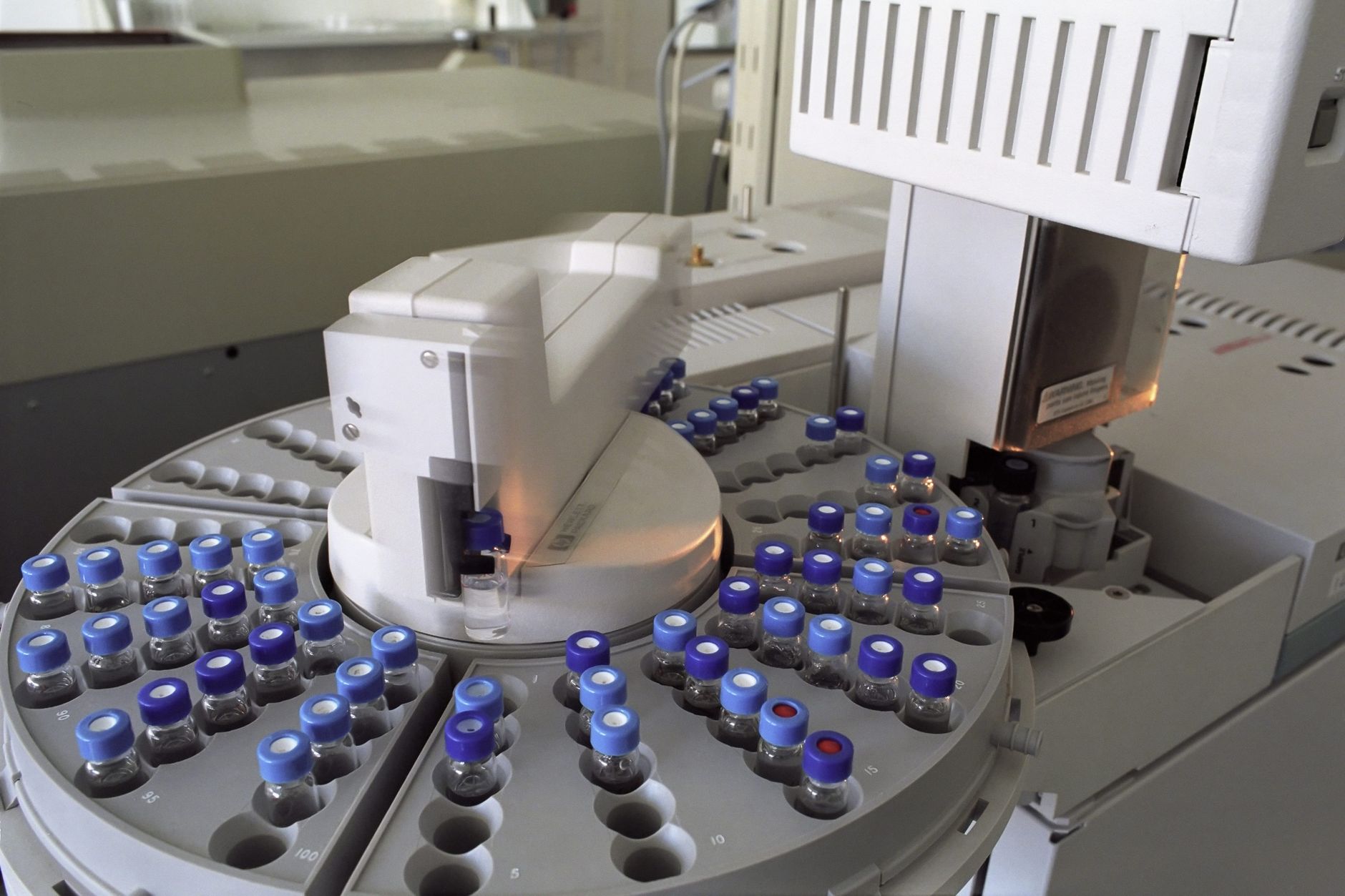
Mass spectrometry HPLC, usually written as HPLC-MS or LC-MS, describes a single analytical setup in which a high-performance liquid chromatography (HPLC) separation feeds directly into a mass spectrometer (MS). The chromatograph answers a question about composition: how much of the sample sits under the main peak. The mass spectrometer answers a question about identity: what that peak weighs, and therefore whether it is the molecule claimed. On a certificate of analysis (CoA) for a research peptide, the two are often reported side by side, and reading them together is what makes the document meaningful. These materials are supplied for research use only.
What does the term mass spectrometry HPLC actually describe?
The phrase points to a coupled, or hyphenated, technique rather than two unrelated tests. In a standalone HPLC run, the separated components pass a detector that records a trace called a chromatogram, and purity is reported as the target peak expressed as a percentage of total peak area, for example 99.0%. In a coupled system, the same separated stream continues into a mass spectrometer, which ionises the eluting material and measures its molecular mass. The practical consequence is that the mass measurement is tied to a specific peak in the separation, not to the vial as a whole. That linkage is the entire point of the hyphen. When a vendor writes HPLC-MS or LC-MS on a CoA, they are claiming that identity was confirmed on material that had already been chromatographically resolved. Whether the supporting data actually shows that is a separate question, addressed further down.
How does a coupled HPLC-MS analysis work in practice?
The sample is dissolved and injected onto a chromatography column, where components move at different speeds and emerge, or elute, at different times. Each elution event produces a peak on the chromatogram. The eluting liquid then enters the mass spectrometer interface, where the molecules are converted into charged ions, typically by electrospray ionisation. The instrument measures the mass-to-charge ratio of those ions, and software reconstructs the underlying molecular mass. Peptides commonly produce several multiply charged ions from the same molecule, which is why a raw mass spectrum can look busier than expected and why a deconvoluted mass is usually reported alongside it. Two outputs therefore matter on a coupled report: the chromatogram showing the separation, and the mass spectrum or reported observed mass showing what the main peak is. Either one alone leaves half of the question unanswered.
Why do purity and identity have to be answered separately?
Purity and identity answer different questions, and no amount of one substitutes for the other. A chromatogram can show a single sharp peak accounting for nearly all of the total peak area, and that result is compatible with the vial containing a very clean sample of entirely the wrong molecule. Chromatography measures relative abundance and separation quality, not molecular structure. Mass spectrometry is what rules out a substitution or a mis-synthesis, because it compares the measured molecular mass against the theoretical mass of the claimed peptide sequence. Conversely, a correct mass on its own says nothing about how much unrelated material is present, since a minor component can still be detected in a heavily contaminated sample. A useful CoA presents both, and a reader who wants a deeper comparison of the two methods can consult our guide on purity versus identity testing methods. The scoring framework behind our vendor transparency methodology treats the presence of both as a documentary property, not a marketing claim.
What should the LC-MS portion of a certificate contain?
At minimum, a credible coupled report identifies the compound analysed, states the theoretical or expected molecular mass for that sequence, and states the observed mass actually measured. It should be accompanied by the underlying data rather than a bare verdict such as identity confirmed. The chromatogram, not just a number, is the real evidence on the separation side, and a mass spectrum or a clearly labelled deconvoluted mass is the equivalent on the identity side. Supporting metadata carries as much weight as the result itself: the name of the laboratory that performed the analysis, the batch or lot number, and the date of analysis, because results describe a batch at a point in time. Method details such as column type, mobile phase and detection wavelength are a further sign that a real run took place. Our guide to the anatomy of a peptide CoA covers these fields in order.
Can one coupled run replace separate HPLC and MS testing?
Often yes, technically, but only if the report presents both outputs. The risk with a single coupled run is documentary rather than scientific: a vendor can perform an LC-MS analysis and publish only the fragment that flatters the product. The table below sets out what each configuration answers and what to look for.
| Configuration | Question answered | Evidence to look for |
|---|---|---|
| HPLC alone | Purity, as % of total peak area | Full chromatogram, retention time, method conditions |
| MS alone | Identity, by molecular mass | Observed mass against theoretical mass, spectrum |
| Coupled HPLC-MS | Both, with identity tied to a separated peak | Chromatogram plus spectrum or deconvoluted mass, same batch and date |
A report that says LC-MS in the heading but shows only a percentage figure is functionally an HPLC result with a stronger-sounding label.
What does mass spectrometry HPLC not tell you?
A coupled purity and identity analysis describes composition. It does not describe safety, and it should never be read as a safety guarantee. Three specific gaps are worth naming. First, net peptide content is a different figure from chromatographic purity: it accounts for water, salts such as trifluoroacetate or acetate, and counter-ions, and it is determined by amino acid analysis or nitrogen determination rather than by HPLC-MS. A sample can be high in area purity while a meaningful share of the vial mass is not peptide at all. Second, endotoxins, which are bacterial lipopolysaccharides, are measured by the Limulus Amebocyte Lysate (LAL) assay and reported in EU/mg or EU/mL under USP <85>. Third, sterility, meaning the detection of viable microorganisms, is a separate test again under USP <71>. A standard purity and identity CoA usually contains none of these, and that absence is common rather than sinister.
What are the red flags on an HPLC-MS certificate?
Most weak certificates fail on documentation rather than on chemistry. Watch for the following:
- A stated purity percentage with no chromatogram behind it.
- An identity confirmed statement with no observed mass and no spectrum.
- No laboratory name, or a laboratory that cannot be shown to exist.
- One generic certificate reused across every product, with no batch or lot number.
- A batch number on the document that does not match the number printed on the vial.
- No date of analysis, which makes the result impossible to tie to a production run.
- CoAs available only by email on request after purchase.
- A verification code, QR link or portal that leads nowhere.
None of these findings say anything about the material itself. They say that the reader has been given no way to check, which is the property the scorecard measures.
How do you verify a coupled report at the source?
Verification means confirming the document with the party that produced it, not with the party selling the product. Start with the laboratory name: independent third-party testing laboratories such as Janoshik or MZ Biolabs can be looked up, and our overview of what independent third-party testing means explains why a named lab outranks a phrase like tested by a US lab. Next, check that any verification code or QR resolves on the laboratory's own domain, rather than opening a PDF hosted only by the vendor. Then confirm that the batch number, the date and the compound name on the report match the vial in hand. Accreditation to ISO/IEC 17025, the standard for testing laboratory competence, is a stronger signal than an unaccredited lab. Transparency is a documentary property, and the ranked vendor transparency scoreboard applies exactly this checklist across vendors.