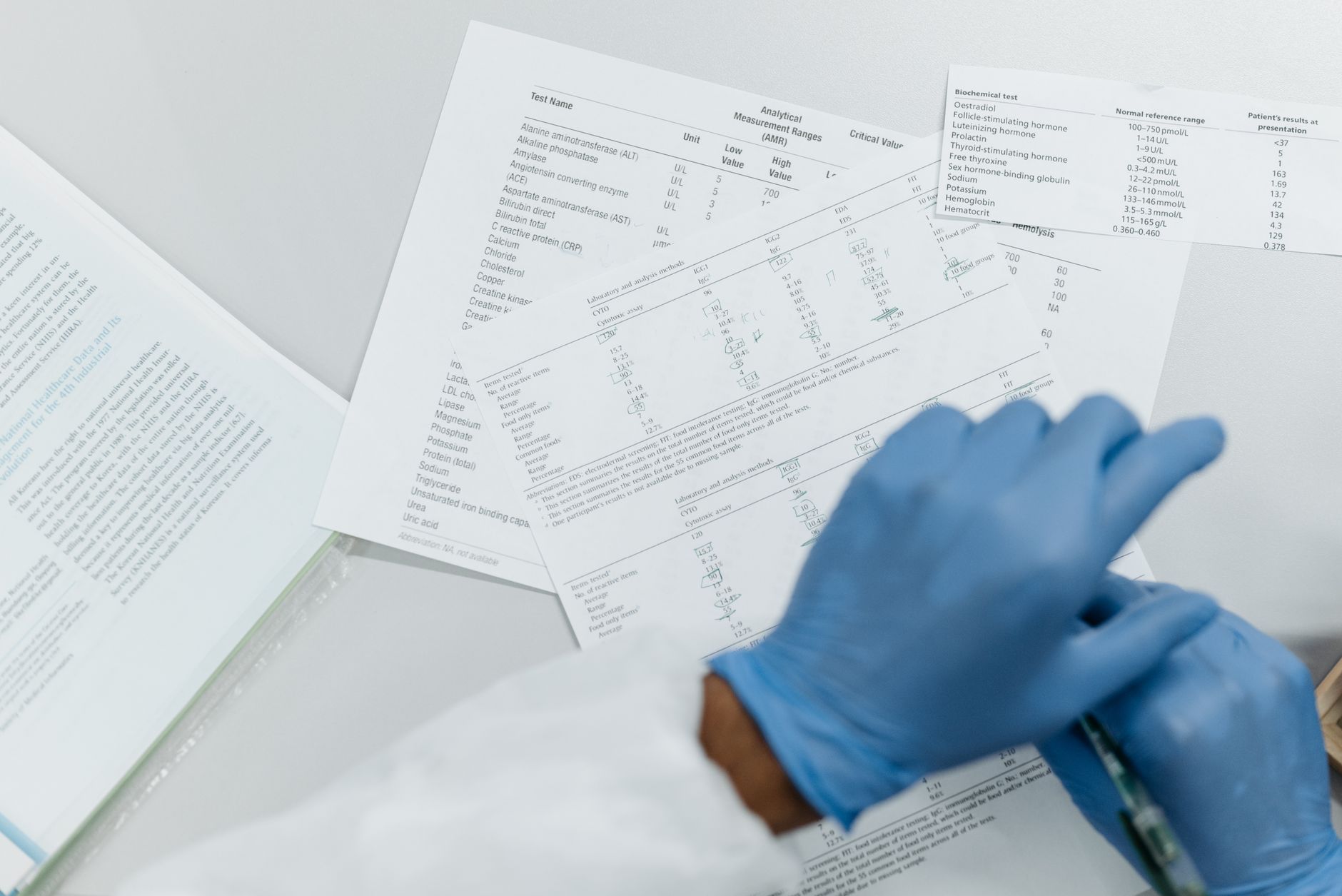
Janoshik Analytical is an independent testing laboratory whose reports circulate widely in the research-peptide market, both published by vendors and commissioned directly by buyers. A Janoshik test result is a document that reports the measured composition of one submitted sample: typically purity by high-performance liquid chromatography (HPLC), identity by mass spectrometry (MS), and the quantity of peptide found per vial. This guide explains what those sections mean, how to confirm a report is genuine using the laboratory's own verification mechanism, and where the evidence stops. It is not an endorsement of this or any laboratory, and it contains no guidance on using any compound. Research peptides are sold for research use only.
What is actually inside a Janoshik test report?
A typical report from this laboratory combines three distinct measurements, each answering a different question.
- Purity by HPLC: the sample is separated into peaks and the target peak is reported as a percentage of total peak area, for example 99.0%. The chromatogram, the plotted trace showing those peaks, is the real evidence; the percentage is only a summary of it.
- Identity by mass spectrometry: MS measures molecular mass to confirm the substance is the peptide claimed. This matters because a sample can be 99% pure and still be the wrong molecule. MS is what rules that out.
- Quantity per vial: the measured mass of peptide found in the container, compared against the labelled amount.
Purity and identity answer different questions, and quantity answers a third. A report that shows only one of the three is a narrower document than it first appears. For the method-level difference between these techniques, see our guide on purity versus identity testing.
How do I verify a Janoshik report at the source?
A PDF is a file, and files can be edited. The only meaningful check is whether the report resolves on the laboratory's own domain. Janoshik reports carry an identifier (a report number, and in many cases a QR code) that can be entered into the laboratory's public verification page, which returns the stored record for that report. If the identifier returns nothing, or if the retrieved record disagrees with the PDF you were shown on compound, purity, date, or quantity, the document in front of you is not evidence.
Three practical points. First, type the code into the laboratory's site yourself rather than following a vendor-supplied link, since a link can point anywhere. Second, compare every field, not just the headline percentage. Third, a report hosted only on a vendor's server, with no working verification route, is an unverified claim regardless of how professional the layout looks. Our walkthrough on reading a certificate of analysis and its red flags covers the same discipline applied to any laboratory's paperwork.
What does a Janoshik result not prove?
This is the section most often skipped. A report describes one sample, from one batch, on one date. It says nothing about the vial you will receive unless that vial's batch or lot number matches the number on the report.
- It is not a batch guarantee. Results describe a batch at a point in time. The next production run is a separate question requiring separate paperwork.
- It is not a sterility or endotoxin result. Endotoxins (bacterial lipopolysaccharides) are measured by the LAL (Limulus Amebocyte Lysate) assay and reported in EU/mg or EU/mL, under USP <85>. Sterility, the detection of viable microorganisms, is a separate test under USP <71>. Passing one does not imply the other, and a standard purity and identity report usually includes neither.
- It is not a safety statement. A composition document describes what is in a container, not whether anything is safe.
- Purity by area is not net peptide content. Net content (by amino acid analysis or nitrogen determination) is a separate figure that accounts for water, salts such as TFA or acetate, and counter-ions.
How do vendors misuse Janoshik reports?
Because the laboratory's name carries recognition, the report itself becomes a marketing asset, and that is where misuse begins. Transparency is a documentary property, not a marketing claim, so each of the patterns below should be checked rather than assumed.
- Stale reports: a result from an old analysis date presented as current evidence for stock sold today.
- Borrowed reports: a report commissioned by a third party, or by a different seller of the same raw material, republished as the vendor's own.
- Orphan reports: no batch or lot number, so nothing on the vial can be matched to the document.
- One report, whole catalogue: a single certificate used to imply quality across every product listed.
- Number without trace: a purity figure quoted in product copy with no chromatogram and no retrievable report.
- Dead verification: a QR code or portal link that leads nowhere.
- Gated documents: reports available only by email on request, after purchase.
None of these are faults of the laboratory. They are faults in how a seller presents documents, and they are exactly what a transparency assessment is designed to detect.
How does a Janoshik report compare to accredited laboratory testing?
Independent laboratories vary in scope and in formal accreditation status. ISO/IEC 17025 is the international standard for the competence of testing laboratories, and a laboratory holding that accreditation for a given method is a stronger documentary signal than one without it. That is a statement about paperwork and oversight, not an accusation against unaccredited laboratories, many of which produce careful work.
| Attribute | What to look for | Why it matters |
|---|---|---|
| Named laboratory | A specific, findable laboratory such as Janoshik or MZ Biolabs | "Tested by a US lab" with no name cannot be checked |
| Verification route | Code resolving on the laboratory's own domain | Removes reliance on a vendor-hosted PDF |
| Accreditation | ISO/IEC 17025 scope, where stated | Independent assessment of method competence |
| Batch linkage | Lot number matching the vial | Connects the document to the physical product |
Our guide on what independent third-party testing means explains why commissioning party and sample chain of custody affect how much a report can carry.
How does PeptideTrust treat Janoshik reports in scoring?
The scorecard rates vendors on documentary transparency only, never on product quality, and never by laboratory brand. A Janoshik report earns credit for the same reasons any report does: the laboratory is named and independent, the document is published openly rather than on request, it carries a batch number and an analysis date, the chromatogram is present rather than only a summary figure, and the result can be verified at the source on the laboratory's domain. A report that fails those tests scores no better for bearing a recognisable laboratory name.
The ten weighted criteria, and how each piece of evidence is counted, are set out in our scoring methodology. Once you can read a report and verify it yourself, the checklist in this guide is the same one applied across every vendor on the transparency scoreboard. Nothing here is medical, dosing, or safety advice, and no compound discussed is presented as having any effect.